Give a product requirement a clear owner, meaningful relationships and a reviewable history. Keep the reason for a design decision connected to the evidence used to assess it.
Start with the need. Give every requirement a reference.
Requirements capture what a product is expected to do. Managing them gives that intent an identifiable source, owner and revision before design and verification decisions depend on it.
Begin with a question a team can answer: which need does this design address, and which requirement version is being reviewed? Keep the statement, the related product context and the review decision distinguishable. These relationships let reviewers revisit the reason for a product decision.
Watch the requirements webcast
Manage Requirements Traceability Throughout the Product Lifecycle
Webcast and demonstration · 21:52
Follow a requirements-and-validation discussion across the product lifecycle, then use your own requirement to evaluate the application scope.
Give each discipline a useful place in the conversation
Different disciplines. A shared understanding of intent.
A requirement can cross engineering, test and supplier boundaries. A managed reference helps participants discuss the same revision instead of relying on an isolated email attachment.
Bring the right question
A mechanical team may need a mounting constraint while a software team needs the intended operating behavior. Identify the relevant statement and the person able to clarify it; sharing a whole document is not a substitute for that conversation.
A supplier comment may reveal an ambiguity without authorizing a design change. Agree how a question is recorded, who evaluates it and how the response returns to the people affected.
A review needs a clear record of what was considered and what remains unresolved. Name the requirement revision and the intended product configuration so a later participant can follow the decision.
Traceability provides a route from requirement intent to verification work. Review the applicable intent alongside the activity and result used to assess it.
Consider an industrial enclosure whose intended operating environment changes. Use this illustrative review path to identify the revised requirement, examine the verification reference and record any questions requiring a decision.
Requirement revision
Identify the proposed behavior, its source and the revision being assessed.
Verification reference
Find the relevant activity and establish which product configuration it addresses.
Recorded conclusion
Review the result, document open questions and assign the next decision to an owner.
Translate a capability into an evaluation question
Author. Review. Verify. Put requirements into practice.
Use these capability areas to structure a demonstration. Keep the selected requirements application, supported interfaces and deployment scope explicit.
Author & review
Shape the statement and the conversation.
Structured authoring
Maintain requirement statements in an organized hierarchy.
What to evaluate
Ask an author to revise one statement and show how its identity and related context remain recognizable to a reviewer. Evaluate the actual content model rather than the appearance of an editor.
Review and feedback
Bring document and item reviews into a defined working process.
What to evaluate
Follow one comment from submission to response. Establish who can contribute, what the owner must resolve and how the reviewed revision is identified.
Verify & report
Make the evidence reviewable.
Verification planning
Relate managed requirements to verification activities.
What to evaluate
Choose one requirement with an existing activity and result. Ask the team to explain applicability, missing evidence and the person responsible for the conclusion.
Traceability reporting
Make relationships and review history available for examination.
What to evaluate
Ask a reviewer to explain a report using its requirement version, product context and evidence. The output supports an investigation; it does not by itself establish compliance or approval.
Exchange & connect
Define how records cross boundaries.
Requirements exchange
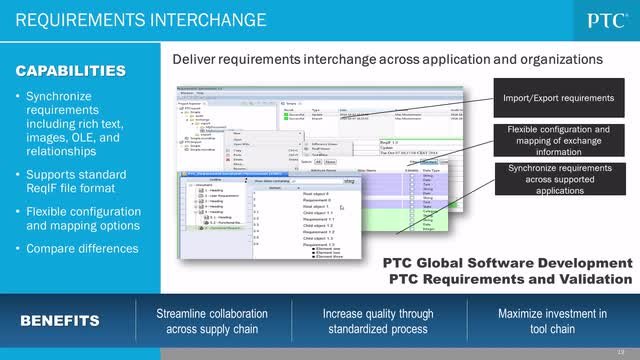
Evaluate ReqIF mappings for supported application exchanges.
What to evaluate
Inspect a representative handoff for identifiers, attributes and changed statements. Agree who reconciles differences and how a returned file is reviewed; file exchange is not automatically a live connection.
Standards-based connections
Scope supported OSLC and API relationships between systems.
What to evaluate
Decide where each record is authoritative before demonstrating a link. Check permissions, releases and change handling across the proposed PLM, ALM or model-based engineering connection.
Plan access and operation around the participating teams.
What to evaluate
Review user groups, information boundaries and operational responsibilities with the administrator. Validate the proposed deployment against your actual collaboration scope.
Subscription and support scope
Match software access and support to the intended use.
What to evaluate
Confirm the selected products, interfaces and entitlements before planning rollout. Review which responsibilities belong to the software supplier and which remain with your organization.
Capability availability depends on the selected products, releases, licensing and configuration. A PLM implementation should not be assumed to include every requirements or verification application.
Put requirements in the wider product context
Connect intent to the product. Explore the Windchill foundation.
Windchill provides the PLM setting for product definitions and controlled engineering work. Evaluate how requirements records should relate to that setting, including the applications in which those records are maintained.
Windchill
For a useful first discussion, bring a product reference and a requirement that influences it. Identify the owners on each side, the relationship reviewers need to follow and how a proposed revision enters the established change process.
Physical product context and application-lifecycle work can have different systems of record. Choose the relationship deliberately instead of duplicating every record in both places.
A requirement gains meaning from the product behavior and evidence it addresses. These starting situations help select a manageable requirement-to-product relationship for evaluation.
Electronics & High-Tech
A connected product requirement may cross a board, enclosure and software interface. Identify the responsible disciplines and the evidence each contributes.
Which teams need to review the same behavior and its supporting evidence?
A device requirement needs an identifiable source, responsible reviewer and supporting verification context. Retain the reasoning behind the relationship.
What evidence will the team consider when reviewing this requirement?
Requirements questions. Connect intent and evidence.
Keep the content, its relationships and the review decision distinct.
Is a requirements document enough?+
A document can capture statements. Managed requirements add maintained identities, versions and relationships within the selected process and application. Begin with the review problem you need to solve rather than assuming a particular document format is the problem.
Does a trace link prove that a requirement is satisfied?+
No. A link identifies a relationship. Reviewers still need to examine the applicable requirement version, verification activity, result and product context before drawing a conclusion.
Is ReqIF exchange the same as continuous synchronization?+
No. File exchange needs agreed mappings, identifiers and handling of changes. Any ongoing synchronization or live-link behavior depends on the supported applications, interface and configured workflow.
Should every requirement be stored in the PLM system?+
Define authoritative ownership for each record. Requirements, software work and physical product definitions may be managed in different applications. Scope the necessary links or exchanges and verify them with the people who own those systems.
Your next requirements decision
Start with the intent. Connect the next decision.
Bring a requirement, a proposed change or a verification question. TriStar can help define the relationships, applications and review scope worth evaluating.